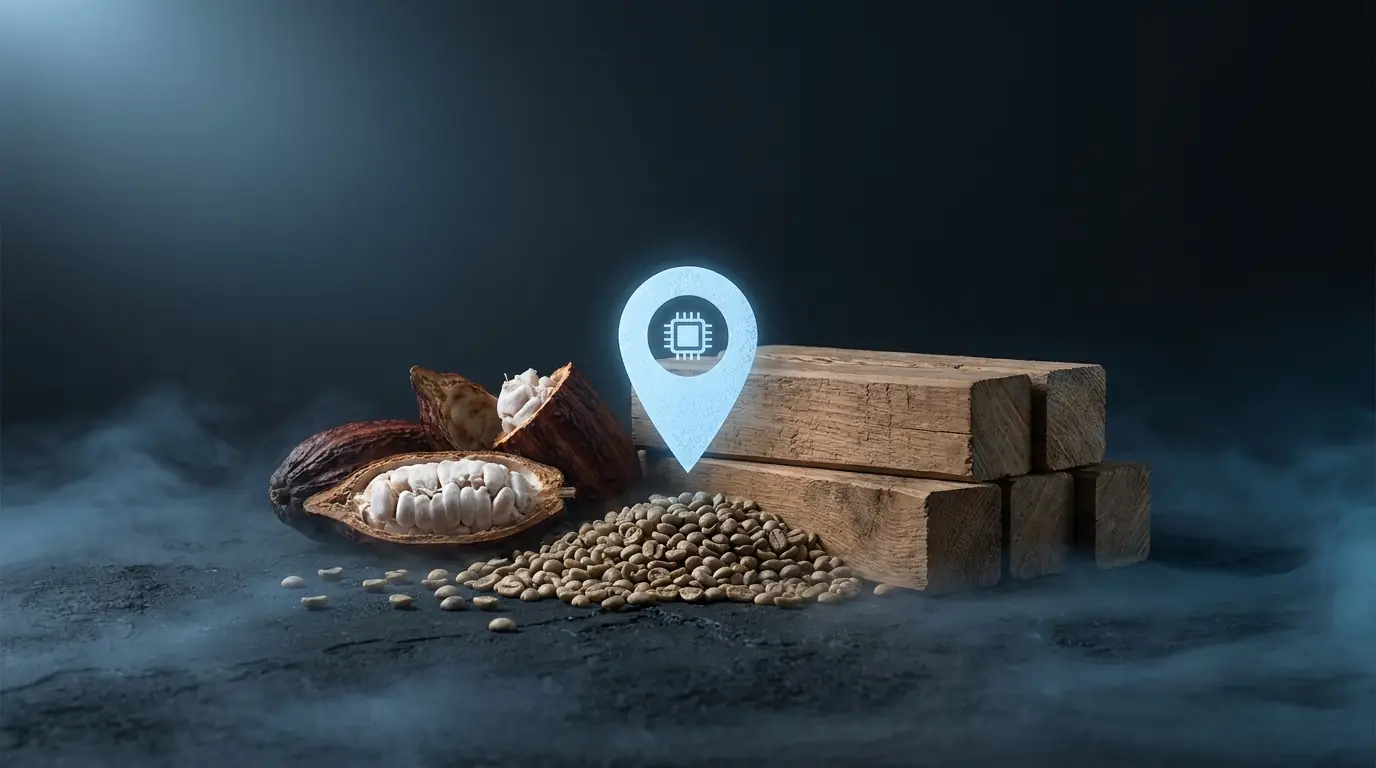
EUDR provenance from plot to port.
Deforestation due diligence under Reg. (EU) 2023/1115 — the EU Deforestation Regulation.
Aeroz binds each lot to the GPS coordinate of its production plot and keeps custody intact to the EU market — so your due-diligence statement is export-ready, not reconstructed.
Seven commodities. One provenance layer.
The EUDR covers seven commodities and the products derived from them. Each must be proven deforestation-free and traced to the plot it was produced on.
Cocoa
Beans and derived products, traced to the producing plot.
Coffee
Green and roasted, bound to its origin geolocation.
Timber
Wood and wood products across the processing chain.
Palm oil
Oil and derivatives, plot-verified at source.
Rubber
Natural rubber and derived goods, traced to plot.
Soy
Beans, meal, and oil, bound to the production parcel.
Beef
Cattle and derived products, traced to the holding.
Derived products
Goods made from each commodity inherit the same trace.
Custody breaks. The statement can't.
EUDR requires operators to prove the GPS plot of production for every consignment, and to keep that link intact all the way to the EU market. Where lots are mixed, repacked, or change hands, the chain of evidence quietly breaks.
When the link breaks, the due-diligence statement becomes a reconstruction — slow to assemble, hard to defend, and exposed at the border.
 Plot · custody · port
The plot, bound to the lot.
At origin, a unit or lot chip is bound to the GPS coordinate of the production plot. From there, every handoff — aggregate, process, ship, receive — writes a custody event to an append-only log.
When the consignment reaches the EU market, the due-diligence statement exports straight from that record, structured for the EUDR Information System — no reconstruction needed.
Every consignment, defensible at the border.
Plot geolocation
The GPS coordinate of the production plot, bound to the lot at origin.
Custody chain
Each handoff — aggregate, process, ship, receive — as an append-only event.
Due-diligence export
Statements generated for the EUDR Information System in seconds.
Deforestation-free evidence
Plot-level evidence tied to each consignment crossing the EU border.
Mixing & lot integrity
Visibility where lots aggregate or repack, so a break in the link shows up.
Regulator-ready record
One source of truth a competent authority can pull, not reconstruct.
One origin, one consignment, border-tested.
We start at one origin: plot polygons are captured and bound to lots at intake, so provenance travels with the physical consignment instead of a spreadsheet. Before you rely on it, we run a due-diligence statement export against a real shipment — a border dry-run that proves the DDS assembles itself from the custody log.
 Export · DDS-ready at the border
FSMA 204 and EUDR, by what you grow or make.
Each guide sets out the records the rule requires, the dates, and the hard part for that product.
FSMA 204 · compliance date 20 July 2028
The FSMA 204 hub: who it covers, what to record, and the 24-hour rule →
FSMA 204 for fresh produce
Leafy greens, fresh-cut produce and the CTE/KDE records they need.
Read the guide → SeafoodFSMA 204 for seafood
Finfish, crustaceans and shellfish, and the first-receiver problem.
Read the guide → Cheese and dairyFSMA 204 for cheesemakers
Which cheeses are on the list, and the records they need.
Read the guide → Shell eggsFSMA 204 for shell eggs
Lot codes, CTEs and KDEs for producers and packers.
Read the guide → Nut buttersFSMA 204 for nut butters
The traceability records processors and brands must keep.
Read the guide → Ready-to-eatFSMA 204 for ready-to-eat food
Deli salads and other ready-to-eat foods on the list.
Read the guide → CarriersNFC or QR for food traceability
Where printed GS1 codes do the job, and where RFID pays for itself.
Read the guide → ChecklistThe FSMA 204 checklist
Every FSMA 204 record on one page, as a free PDF.
Get the checklist →EUDR · deforestation-free due diligence
The EUDR hub: the dates, who files the statement, and the September 2026 product list →
EUDR for cocoa
Plot-level due diligence across millions of smallholder farms.
Read the guide → CoffeeEUDR for coffee
Geolocation-backed due diligence for every EU consignment.
Read the guide → Palm oilEUDR for palm oil
Geolocation, due-diligence statements and the 2020 cut-off.
Read the guide → SoyEUDR for soy
Plot geolocation for one of the EU’s largest farm imports.
Read the guide → RubberEUDR for rubber
Natural rubber and tyres, across the most fragmented chain.
Read the guide → Cattle and beefEUDR for cattle and beef
Birth-to-slaughter traceability for live cattle and beef; hides and leather left the list in 2026.
Read the guide → TimberEUDR for timber and furniture
EUDR and the furniture passport, answered from one record.
Read the guide →From the Aeroz blog
- Extra Virgin Olive Oil Fraud: How It Happens and What to Check.
- Is Your Protein Powder Genuine? How to Check the Tub You Bought.
- If You Have Taken a Supplement in the Last 30 Days, Read This
- The FDA Doesn’t Test Your Supplements: Inside the $50 Billion Regulatory Loophole
More answers: FSMA 204 questions in the compliance FAQ
Know where you stand on EUDR — in 14 days.
A fixed-fee Aeroz audit produces a written gap analysis against Reg. (EU) 2023/1115, a geolocation and custody-readiness assessment of your chain, and a scoped pilot plan with cost and timeline.
What's included
- Reg. (EU) 2023/1115 gap analysis against your current chain.
- Geolocation readiness for plot-of-production binding.
- Custody-integrity review at aggregation and repack points.
- Due-diligence statement mapping to the EUDR Information System.
- Pilot scope for plot-to-port provenance on one commodity.