Originally published on Medium.
Halloween makeup and costume contact lenses: what the label cannot tell you
By Aeroz Editorial September 2026 · updated 24 October 2026
FDA does not approve cosmetics before they go on sale, and every contact lens is a medical device, decorative ones included. Tests have found heavy metals in children’s face paint and microbial contamination on 60 percent of counterfeit lenses. A week before Halloween, here is what the box cannot tell you, and what to check before October 31.
This guide brings together our two Halloween posts from September 2026, on face paint and on costume contact lenses, with every figure checked again against its source.
Face paint: nobody checked it before it reached the shelf
Most parents assume that a face paint kit on a store shelf has cleared some kind of safety review. It has not. Under U.S. law, cosmetic products and their ingredients do not need FDA approval before they go on sale; the one exception is color additives, which FDA must approve for their intended use. FDA can act against an unsafe or mislabeled cosmetic after it is sold. The company that makes it is responsible for its safety before then.
That matters more for Halloween makeup than for most cosmetics. It is bought quickly, once a year, often for the lowest price, and it is applied to children’s skin, around their eyes and near their mouths.
What testing has found is a reason to choose carefully. In 2016 the Breast Cancer Fund sent 48 Halloween face paints to an independent laboratory; 21 of them, almost half, contained trace amounts of at least one heavy metal. CDC’s position on lead is blunt: no safe blood lead level in children has been identified. And in 2019 FDA’s own testing found asbestos in several talc-based makeup products sold by Claire’s and Justice, two retailers whose customers are mostly children and teenagers, and FDA warned consumers not to use them.
Face paint near the mouth does not stay on the skin. Over an evening of trick-or-treating, some of it is swallowed with the candy. That is one more reason to use a product you can trace to its maker, and to wash it off before bed.
Bought online, from a third-party seller
The other risk is that the kit is not what its label says. In a 2018 investigation (GAO-18-216), the U.S. Government Accountability Office bought 47 popular products from third-party sellers on five major e-commerce sites. The rights holders found 20 of them were counterfeit, including all 13 of the branded cosmetics GAO bought. That test covered a small, specific sample, not every seller on every platform, but the pattern is the one to keep in mind when a branded palette is selling well below its usual price.
Costume contact lenses: sold without a prescription, which is illegal
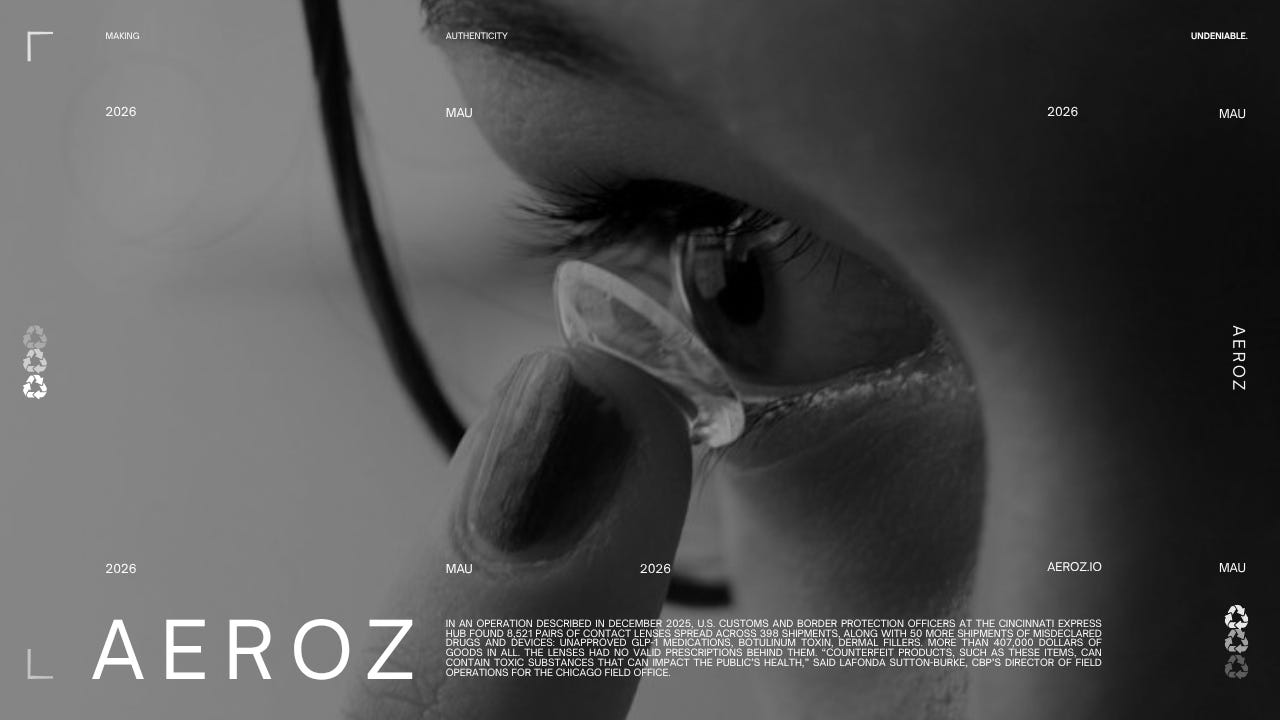
U.S. Customs and Border Protection officers at the Cincinnati express hub found 8,521 pairs of contact lenses spread across 398 shipments, along with 50 more shipments of misdeclared drugs and devices: unapproved GLP-1 medications, botulinum toxin, dermal fillers. More than 407,000 dollars of goods in all. The lenses had no valid prescriptions behind them. “Counterfeit products, such as these items, can contain toxic substances that can impact the public’s health,” said LaFonda Sutton-Burke, CBP’s Director of Field Operations for the Chicago Field Office.
Parcels like those go to individual buyers, and in October some of those buyers are parents, ordering a pair of cat’s-eye or white-out lenses for a costume, at a price FDA has noted can be “as little as $20,” from a site that never asked for a prescription because it never intended to.
What the law says, in FDA’s words
There is no gray area here, and the wording is FDA’s own.
“Decorative contact lenses are not cosmetics or over-the-counter merchandise. They are medical devices regulated by the U.S. Food and Drug Administration.” That includes lenses with no vision correction at all, the ones sold purely for color or effect: “All contact lenses must be prescribed by a doctor, including decorative lenses.”
On sellers: “Places that advertise them as cosmetics or sell them over-the-counter, without a prescription, are breaking the law.” FDA names where that happens: street vendors, beauty supply stores, flea markets, novelty stores, Halloween stores, and unknown online distributors. On the lenses themselves: “Any contact lenses that are not prescribed by a doctor are illegal and could cause you harm.”
The harm is not theoretical. FDA lists scratches on the cornea, corneal infection, conjunctivitis, decreased vision and blindness, and adds a line worth reading twice: “Bacterial infections can be extremely rapid, result in corneal ulcers, and cause blindness, sometimes within as little as 24 hours if not diagnosed and treated promptly.”
None of this is new. In October 2004 FDA’s acting commissioner, Lester Crawford, warned that decorative lenses sold without a prescription “are illegal and can cause serious eye injury and even blindness,” and promised the agency would “aggressively use the full range of its statutory authorities” against their distribution. Twenty-two years on, the shipments are still arriving by the hundred at a single express hub.
What is on the lens
The reason the law treats a colored lens like a corrective one is that it sits on living tissue, and FDA’s own scientists have measured what arrives on the illegal ones.
In a study published in 2017, FDA researchers examined more than 300 individual contact lenses obtained from import seizures, novelty stores, tattoo parlors, flea markets and internet marketplaces. Among counterfeit lenses, meaning lenses sold under a real manufacturer’s name and packaging, 60 percent carried microbial contamination, 37 of 62 samples. Among unapproved non-corrective lenses, lenses with no FDA clearance at all, 27 percent did, 61 of 233. Among authentic, prescribed lenses, 3 percent. Of the 29 counterfeit brands in the sample, 48 percent had at least one contaminated lens.
The organisms included Pseudomonas aeruginosa, a bacterium found in hospital wastewater and associated with microbial keratitis, and Bacillus cereus, found in spoiled food. Dr. Edward Bennett, then chair of the American Optometric Association’s Contact Lens and Cornea Section, drew the line plainly: “We know that if the lens is contaminated and there is a break in the corneal epithelium, the risk of eye infection is very real.”
Read those two groups together. The unapproved lens is dangerous because nobody checked it. The counterfeit lens is more dangerous, and it is the one wearing a name you would recognize, in a blister pack that looks like the one your optometrist hands you.
Why the box cannot help
Everything a buyer can inspect on a contact lens or a face paint kit is on the packaging: the brand, the lot number, the expiry, the words “sterile” or “FDA approved.” Every one of those is a print, and print copies. In the counterfeit group of FDA’s study, the packaging was the point; it is what made a contaminated lens look like a cleared one.
The prescription requirement is a check on the seller, and it works exactly as long as the seller obeys it. Sellers that ship 398 parcels through one hub without asking for a prescription have already decided not to. FDA’s advice to buy only from sellers that require a prescription and offer “FDA-cleared or approved contact lenses” is correct, and it asks a parent to judge a seller from a listing, which is the one thing the listing is designed to make easy.
You cannot authenticate an object with something that can be copied. The mark has to answer differently every time it is asked.
When the product can answer for itself
A cryptographic identity on the sealed blister, vial or kit, embedded rather than printed, changes what a buyer, a pharmacy and a platform can check before the seal is broken.
A tap on the pack answers three questions from the manufacturer’s own record: is this the manufacturer’s product, from which lot, cleared or listed under which FDA record. A counterfeit pack has no identity to answer with. A copied code can be flagged, because a copied identity is not designed to answer a challenge it has not seen. An unapproved product has nothing to say at all, which is its own answer.
For a marketplace, that turns “does this seller require a prescription” into a check that can be made on the item at listing. For an optometrist or pharmacy, it is a half-second confirmation at dispensing. For the manufacturer whose name is on the counterfeit, every flagged tap is a location: where the fakes carrying its name are surfacing, which is where the next 398 shipments are going.
The mechanism is described in how a tap opens a product passport, and brands that sell through marketplaces can see how it fits their channel on our direct-to-consumer page.
What to do before October 31
- Every contact lens needs a prescription, including purely decorative ones. Get an eye exam and a fitting, and buy only from a seller that asks for the prescription.
- If a lens hurts, comes out cloudy, or the eye reddens, take it out and see an eye doctor the same day. The 24 hours FDA mentions are real.
- Buy face paint and makeup from the brand or a store you know, not from a third-party marketplace listing priced well below the usual price.
- Look the product up on FDA’s recalls and safety alerts before you buy, and check that the ingredients are listed on the package.
- Test it first. Put a small amount on your child’s arm a couple of days before Halloween and watch for redness or a rash.
- Keep it away from the mouth and eyes where you can, and wash it all off before bed.
Sources: FDA, cosmetics laws and regulations and decorative contact lens guidance; FDA testing of talc-containing cosmetics, 2019; CDC, childhood lead poisoning prevention; Breast Cancer Fund, “Pretty Scary 2”, October 2016; U.S. GAO, GAO-18-216, 2018; U.S. CBP, Cincinnati seizure release; FDA, 2017 study of seized contact lenses.
Aeroz, Making Authenticity Checkable. Visit aeroz.io to learn more & get in contact with our team via [email protected].
2026 Aeroz all rights reserved.