Originally published on Medium.
A Bangkok clinic, five molecules, 18,178 pharmacies, and a serial number the state has not yet required anyone to print.
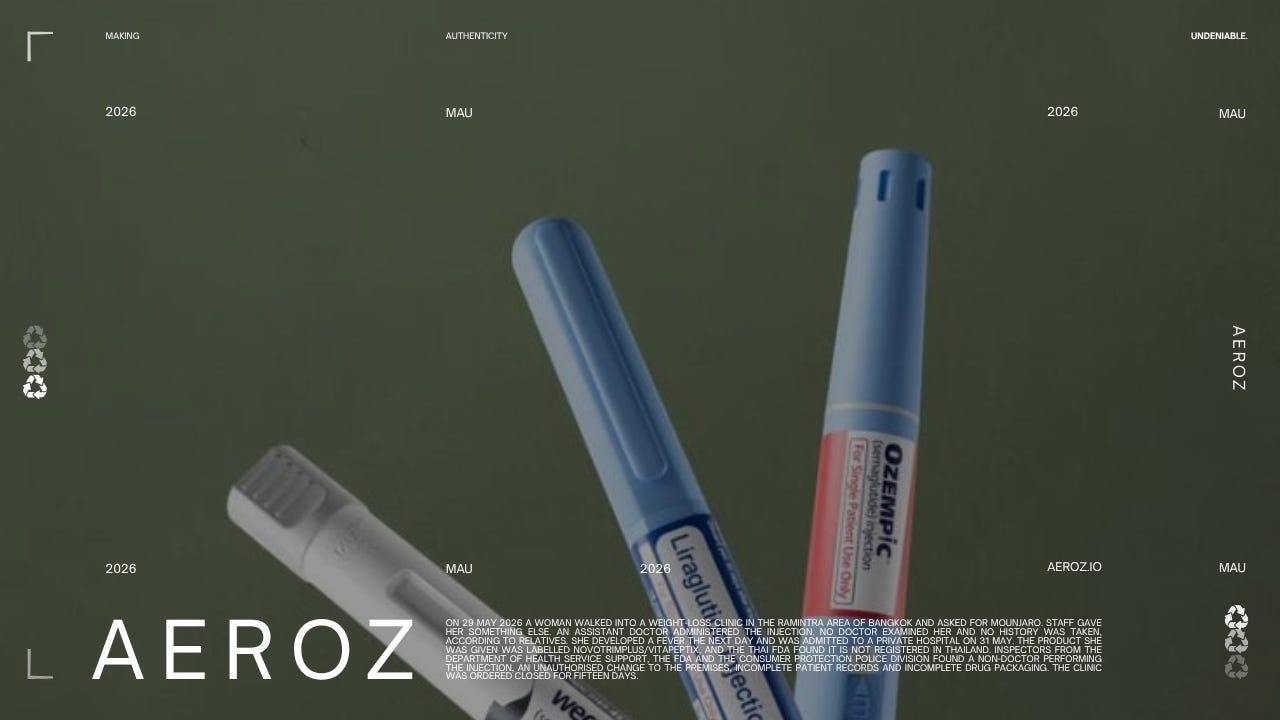
On 29 May 2026 a woman walked into a weight-loss clinic in the Ramintra area of Bangkok and asked for Mounjaro. Staff gave her something else. According to relatives, an assistant doctor administered the injection, no doctor examined her and no history was taken. She developed a fever the next day and was admitted to a private hospital on 31 May. The product she was given was labelled NOVOTRIMPLUS/VitaPeptix, and the Thai FDA found it is not registered in Thailand. Inspectors from the Department of Health Service Support, the FDA and the Consumer Protection Police Division found a non-doctor performing the injection, an unauthorised change to the premises, incomplete patient records and incomplete drug packaging. The clinic was ordered closed for fifteen days.
Three and a half months later, on 15 September 2026, injectable GLP-1 medicines became specially controlled drugs across Thailand. They now require a doctor’s prescription and must be dispensed by a pharmacist. The FDA also pointed patients at something more interesting than a prescription pad: a Track & Trace facility where you can type the serial number printed on the box into the regulator’s own website and see whether it matches an authorised product.
Read the two halves of that announcement carefully and they are not the same kind of thing. The prescription requirement is law, issued under the Drug Act, carrying prison terms and fines. The traceability half is a request. The FDA said it is “initially requesting cooperation” from licensed importers and sellers to submit sales data, and that the detailed rules on sale and distribution are still being drafted. Meanwhile the most established serialisation on Thai GLP-1 boxes, eZTracker, was built by a distributor and adopted voluntarily by a manufacturer, and the FDA’s own Track & Trace sticker is still a pilot that no rule requires. Thailand has made it compulsory to control who hands over the pen. It has left it optional to establish what the pen is.
What the rule actually does
Notification on Specially Controlled Drugs No. 58 was signed on 6 March 2026 by Minister of Public Health Phattana Phromphat and published in the Royal Gazette on 18 March 2026. It takes effect 180 days later, which lands on 15 September. The legal basis is sections 76(4) and 78 of the Drug Act B.E. 2510, acting on a Drug Committee recommendation from a meeting held on 20 September 2024. Two years passed between that recommendation and the rule taking effect, and six months of it was deliberate notice to the trade.
The notification itself is one line. It adds item (100), “injectable Glucagon-like Peptide-1 (GLP-1) drugs,” to a controlled list first issued in 1978. That wording is class-wide, which is the single smartest thing about it. It does not enumerate brands, so it does not go stale when the next molecule arrives.
The five substances everyone has reported, semaglutide, liraglutide, dulaglutide, lixisenatide and tirzepatide, come from the FDA’s press communication on 19 March, not from the text of the notification. The distinction matters for anyone reading the rule to work out whether a product is caught. The test is whether it is an injectable GLP-1, not whether it appears on a list of five.
Oral products are outside it. Rybelsus, the oral semaglutide, is registered in Thailand and is not an injectable, so item (100) does not reach it.
What is compulsory, and what is a request
Selling a specially controlled medicine without a prescription, operating without a drug sales licence, or selling an unregistered medicine each carry prison terms and fines. Unlawful advertising carries a maximum fine of 100,000 baht. In the September enforcement cases the charges actually brought under the Drug Act were selling modern medicine without a licence, carrying up to five years and a fine of up to 10,000 baht, and selling an unregistered drug, up to three years, a fine of up to 5,000 baht, or both. Those fine figures are worth sitting with next to a seller turning over 290,000 baht a day.
The traceability side has no penalty attached because it has no obligation attached yet. At its 14 September briefing the FDA described Track & Trace as a system it is asking licensed importers, orderers and sellers to cooperate with in an initial phase, with detailed criteria still being written. The agency has said it intends to issue a further notification requiring all companies to apply Track & Trace stickers to every GLP-1 product. That is a stated future step, with no date attached, and not current law.
Industry serialisation trackers we checked, such as Antares Vision’s regulatory roadmap, do not list Thailand at all. That is an omission rather than a finding, and it is consistent with the FDA’s own account of a voluntary pilot.
The serial number that already exists, and who owns it
Here is the part that has gone almost unreported. There is working serialisation on Thai GLP-1 boxes right now, and it belongs to Zuellig Pharma.
eZTracker is a traceability platform Zuellig built. In March 2025 Novo Nordisk Pharma (Thailand) Ltd adopted it for Ozempic, the first of its Thai products to carry it. Zuellig had first launched eZTracker in Thailand in 2021, on Galderma’s Restylane fillers. Each box carries a sticker with a 2D code. The buyer scans the code or types the product code into the eZTracker app, a valid product returns its details, and a product that will not scan can be reported in the app. In January 2026 the same system was extended to Wegovy, verified through a pink 2D QR sticker on the box. Novo Nordisk said it had seen a significant reduction in reported counterfeit incidents after the 2025 introduction, and gave no figures for it.
None of the eZTracker announcements mentions the FDA’s Track & Trace system, and none of the FDA’s September briefings mentions eZTracker. There is no public source linking the two. So a patient holding an Ozempic box in Bangkok may have a scannable sticker on it, placed there voluntarily by the manufacturer using a system its distributor built, and separately may be invited by the regulator to check a serial number in a government pilot. Whether those are the same number has not been stated anywhere.
This is not a criticism of Zuellig. A distributor building item-level verification before any law required it is the right instinct and it is ahead of its regulator. The point is what it reveals about where the duty sits. The most established traceability on a controlled medicine in Thailand exists because commercial parties chose to build and adopt it, which means it covers only the products they chose to put it on, lasts as long as they keep it running, and answers to their priorities.
Who actually falls under this
The prescription duty falls on anyone selling or dispensing an injectable GLP-1 in Thailand. The reporting request falls on licensed importers, orderers and sellers. Working out who those are in practice is harder than it should be, and the gaps are part of the story.
At the registration and import layer, the names are clear. Novo Nordisk Pharma (Thailand) Ltd is the registrant of record for Ozempic, with submission numbers on file at the Thai FDA, and is the company of record for Wegovy and for Rybelsus. The Saxenda package leaflet published on the Thai FDA’s website names it as importer. Eli Lilly Asia, Inc. (Thailand Branch) is Lilly’s Thai legal entity, in the country since 1967, and is the company of record in the MIMS Thailand directory for both Mounjaro and Trulicity. Sanofi-Aventis (Thailand) Ltd holds the Thai registration for Soliqua, the insulin glargine and lixisenatide combination, under registration numbers dating to 2017. Whether Sanofi still actively markets it in Thailand could not be established, and nobody should assume either way.
Standalone lixisenatide, sold elsewhere as Lyxumia, does not hold a Thai registration according to a Siriraj Hospital clinical protocol. Nor do Byetta, Bydureon or Tanzeum. The same protocol confirms Thai registrations for Saxenda and Trulicity, and for one product almost nobody has mentioned in connection with this rule: Xultophy, the insulin degludec and liraglutide combination. It is an injectable containing a GLP-1, so on a plain reading the class-wide wording of item (100) appears to catch it. We found no FDA statement or coverage that addresses it.
No liraglutide biosimilar or generic appears in the Thai clinical listings we found. The Siriraj protocol, which enumerates liraglutide products, shows only the Novo originator brands. That is absence of evidence rather than proof, and it will not stay true, because liraglutide is off patent in major markets.
Then there is the distributor layer, where the concentration is remarkable. Zuellig Pharma’s own launch release says it holds the marketing authorisation for Mounjaro in Thailand, and in the same document says Lilly granted it distribution and promotion rights, without reconciling the two statements. MIMS Thailand shows “Distributed by Zuellig Pharma” and “Marketed by Zuellig Pharma” against Eli Lilly Asia Inc Thailand Branch, and shows Zuellig as distributor on Novo Nordisk Pharma (Thailand)’s company page and on the Saxenda page. One distributor therefore sits across both dominant GLP-1 franchises in the country, and separately owns the serialisation running on Novo’s Ozempic and Wegovy. If the FDA’s reporting request is to produce a usable national picture, one company’s cooperation matters more than everyone else’s combined.
A note on who is not in this chain. DKSH has substantial healthcare distribution in Thailand, agreed in August 2026 to acquire a Thai active-pharmaceutical-ingredient distributor, P.R. Chemicals, and distributes for Novo Nordisk Pharmatech, which is an ingredients business. No source places DKSH in the distribution chain for any of these five injectable products, and it would be easy and wrong to put it there.
Below the importers, the picture goes dark. Thailand had 20,733 drug-sale licences as of March 2026, a count that also includes wholesalers, importers and manufacturers. Of them, 18,178 were modern pharmacies, roughly three quarters of those standalone, and 82 per cent outside Bangkok. Hospitals account for around 80 per cent of drug sales and retail pharmacy around 20 per cent. The named chains in the market include Health Up, eXta Plus, Save Drug, Fascino, Pure, Watsons, Boots, Matsumoto Kiyoshi and Tsuruha. Not one of them could be sourced as stocking or dispensing a GLP-1. Every search result claiming to tell you where to buy these drugs in Bangkok turned out to be a clinic marketing page or an expat SEO site. The retail layer that the reporting request is aimed at is, from outside, undocumented.
The hospital layer is slightly better lit and still thin. Novo’s then general manager said in April 2025 that Wegovy was prescribed in private hospitals nationwide and would soon reach public hospitals. At the FDA’s 14 September briefing the agency said it had confirmation from “the importing pharmaceutical company”, which it did not name, that the drugs had been distributed widely to hospitals, clinics and pharmacies. The Thai does not say whether one company or several is meant. Sell-side analysts at Asia Plus expect Bangkok Dusit Medical Services, Praram 9 and Bumrungrad to benefit from the prescription shift, which is an expectation about share prices and not a record of dispensing.
And then the clinics, which is where this article started.
The market the rule is aimed at
The legitimate course is reported to cost between US$240 and US$360 a month, which is the number that explains everything else.
On 20 February 2026 the Consumer Protection Police and the FDA announced raids on three online peptide sellers after working undercover in open chat groups called “Peptide Plus+” and “WellViva PEPTIDE,” which had around 2,600 members between them. The haul was 119,383 items valued at 17,938,000 baht, including roughly 42,000 and 8,000 printed labels at two of the sites. Products arrived as powder plus solvent for buyers to mix and inject themselves. Retail prices ran from 999 to 5,999 baht. Sellers referred to the goods as “coloured pencils.” Reporting on the case noted that the products carried no registration numbers and that buyers had no way of knowing what was in them.
On 11 September the FDA briefed on a house in Bang Yai, Nonthaburi, trading as “Haus of peptide” through a social media account, operating for about a year, employing foreign workers to pack and shipping by private courier. Roughly 100 boxes a day at 2,900 baht a box, around 290,000 baht daily and an estimated eight million baht a month. Seized items included peptide injection vials with no registration number, sterile water, insulin syringes, leaflets, alcohol wipes, packaging boxes and “haus of peptide” stickers. The FDA’s own press release gives the value as “over 50 million baht” in its headline and “over 52 million baht” in its itemised section, and does not reconcile them. The investigation began with a parent’s complaint and ran through the Metropolitan Police Bureau’s Child and Women Protection Division.
In August a woman was arrested in a rented room in Phuket with four “Peptide” weight-loss sets, each holding a 10 mg tirzepatide vial, bacteriostatic water and syringes. The same report noted a separate Suvarnabhumi Airport seizure of 137 tirzepatide packages valued at over 2.13 million baht.
Three different shapes of the same trade: a chat group, a house with a courier account, and a passenger through an airport. In each, nothing on the product could be checked against a manufacturer, and in the two raids the sellers held their own printed labels and stickers.
Thailand got the hard parts right
It would be easy to write this as a regulatory failure and it is not one.
The class-wide wording of item (100) is better drafting than most jurisdictions manage, because it does not need amending when the next molecule launches. Six months of notice between Gazette publication and entry into force gave importers, pharmacies and hospitals time to prepare, rather than a surprise. The FDA protected treatment continuity explicitly: patients with a medical indication who stay under a doctor’s care keep access. It built a consumer-facing check and told people how to use it, with a hotline and an app, instead of only talking to industry. And it named counterfeits as one of three reasons for acting, alongside unsupervised use and illegal online sales, which is more candour than most regulators offer about why a scheduling decision is being made.
Zuellig deserves the same credit. eZTracker exists, it is on boxes, and nobody made the company build it.
What we are not saying
No Thai rule requires a chip, a tag or any physical carrier on a medicine, and nothing in Notification 58 does. The prescription requirement is a good instrument for the problem it addresses, which is unsupervised use of a potent drug.
We are not saying the FDA’s Track & Trace pilot is a failure. A voluntary pilot with criteria still in drafting is an early-stage system, and the agency has said it intends to make the stickers mandatory. That may well happen, and if it does Thailand will be ahead of most of the region.
We are not saying any named company here has done anything wrong. Novo Nordisk Pharma (Thailand), Eli Lilly Asia Thailand Branch, Sanofi-Aventis (Thailand) and Zuellig Pharma are the registered, licensed, legitimate channel. They are named because they are the parties the rule actually binds, which is the question anyone reading it needs answered.
And we are not claiming the retail chains named above do or do not stock these drugs. We could not establish it either way, and that gap is reported as a gap.
Who meets this problem
The woman in the Ramintra clinic, who asked for a named product, was steered to an unregistered one, and had no practical way to check what it was before it was in her arm.
The pharmacist in one of the roughly 14,900 modern pharmacies outside Bangkok, who from 15 September may dispense an injectable GLP-1 only against a prescription, and whose way of checking whether the box in front of her is genuine, unless it carries a scannable sticker, is to look at it.
The compliance team at a licensed importer, which has been asked to cooperate with a reporting system whose criteria have not been published, and which has to decide how much to build before it knows the specification.
The investigator who seizes 42,000 printed labels and has to work out what was in the vials those labels were destined for, by testing contents, because the labels establish nothing.
And the patient who does scan the sticker. On a box distributed through the official channel she gets an answer. On anything else, there may be nothing to scan, or a code that does not check out.
If you are one of these people
If you are a licensed importer or marketing authorisation holder in Thailand
The reporting request is voluntary now and the FDA has said it intends to mandate stickers. Build for the mandate, not the request, and establish today whether the identifier you print can answer a question about one box rather than one consignment. Note also which entity in your structure actually carries the duty: for at least one of these five substances, the distributor has said publicly that it holds the marketing authorisation.
If you are a distributor
You may be the reason a national picture is possible or impossible. One company distributes both leading GLP-1 franchises in Thailand. That is leverage and it is also exposure, because when the mandate lands, the specification will be written around whatever the regulator has seen working.
If you are a hospital or retail pharmacy
From 15 September the prescription is your legal obligation and it is auditable. Selling unregistered or counterfeit medicine is already an offence, but no rule yet gives you a way to prove authenticity box by box, and you will still be the last pair of hands on the box. Decide now what you would do with a pen that does not scan.
If you are a regulator elsewhere in the region
The sequencing in this case is worth copying and worth improving on. Class-wide wording and 180 days of notice are the parts that worked. The part to do differently is to put the identifier obligation in the same instrument as the prescription obligation, rather than leaving it to a cooperation request and a pilot, because the gap between the two is where a clinic in Ramintra operates.
If you are a patient in Thailand
You can check a serial number, and on a box from the official channel you may also be able to scan a sticker. Both only work on product that came through the legitimate channel: a match is reassuring, a failed check is a warning, and a box with nothing to check should itself make you suspicious. Keep the box.
The half that was left optional
Thailand looked at a market full of unregistered injectables sold by chat group and courier, and did two things. It made the prescription compulsory, with prison terms behind it. And it asked the trade, nicely, to help it trace the product.
The first of those is about who may hand you the pen. Only the second is about what the pen is. The clinic in Ramintra had a prescription requirement less than four months away and an unregistered weight-loss pen in use, and it was after an injection from that pen that a woman ended up in hospital.
Aeroz, Making Authenticity Checkable. Visit aeroz.io to learn more & get in contact with our team via [email protected].
© 2026 Aeroz. All rights reserved.