Originally published on Medium.
In Kuwait this week police seized 4,000 perfume bottles and the tool used to seal them. American law has treated an empty liquor bottle as contraband for decades, and once had the prohibition molded into the glass. Europe is now requiring more refillable containers, for good reasons, and nothing in it does the job the American empty-bottle ban did.
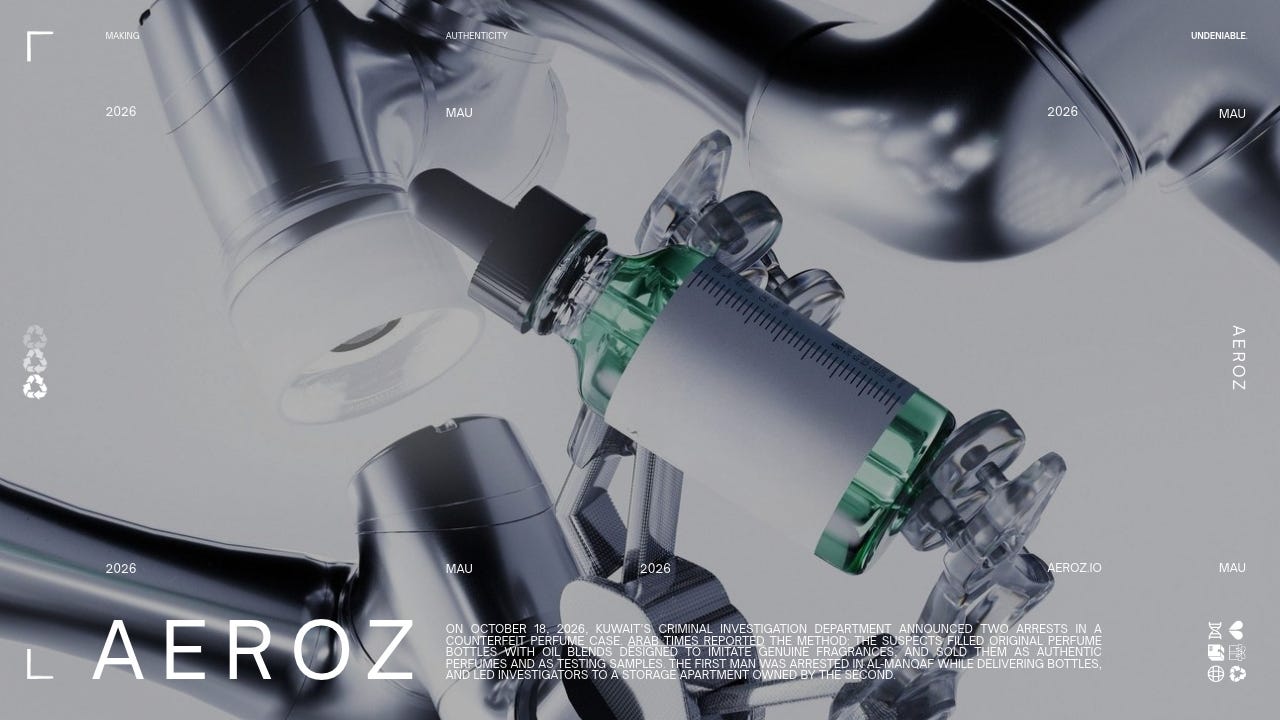
On October 18, 2026, Kuwait’s Ministry of Interior announced two arrests by the Criminal Investigation Department in a counterfeit perfume case. Arab Times reported the method: the suspects filled original perfume bottles with oil blends designed to imitate genuine fragrances, and sold them as authentic perfumes and as testing samples. The first man was arrested in Al-Manqaf while delivering bottles, and led investigators to a storage apartment owned by the second.
The inventory list is the part to read twice. About 4,000 perfume bottles bearing various brand names, four bottles of alcohol, quantities of essential oils, other equipment for preparing and packaging the fragrances, and a tool used to seal perfume bottles.
A sealing tool. Not a forged seal, a device for producing a real one.
Investigators bought three bottles for 17 Kuwaiti dinars. The genuine equivalents were worth 150.
A related method, five days earlier, in Lagos
On October 13, NAFDAC raided a two-storey building at Zamfara Plaza in the BBA Trade Fair Complex on the Badagry Expressway in Ojo, Lagos. Vanguard reported two arrests and the seizure of drums, filters, packaging materials and a heating device. Nairametrics put the operation at over 20 illegal stores working out of makeshift parking spaces, with a value above 2 billion naira, and described the activity as blending and counterfeiting popular alcohol brands, revalidating expired or unsafe drinks for resale, and stockpiling banned imports.
The best line in the coverage is the suspect’s own. Identified by Vanguard as a drinks dealer in the market, the man named Okafor said: “I deal on drinks. I change the bottle of the drink. It’s not that the bottle is not good. It’s the drink in there, because the other one is already damaged. So that’s why we are putting it to the next bottle.”
Whether or not that is the full account, the business runs on the bottle.
Why this is a different problem from a fake
A copy has tells. Print quality, colour, weight, the feel of a cap, a misspelling on a label. The whole practice of consumer counterfeit detection, the “spot the fake” guide, rests on the fake being a reproduction and therefore imperfect.
A refilled bottle has no tells, because nothing about it is a reproduction. The glass is the brand’s glass. The label is the brand’s label, printed by the brand’s printer. The cap may be the brand’s cap. If the bottle carries a batch code, a registration number or a QR code, all of them are genuine and all of them will verify correctly, because they were issued for that bottle.
Then the seal is restored with a tool bought for the purpose, and the one physical signal that the container has been opened is gone.
What is false is the only thing nobody can read: the contents.
The pattern across categories
This keeps appearing, and not in luxury goods.
Drinking water, Nigeria. NAFDAC’s enforcement summary for the year to June 2026, reported by Vanguard, included three companies caught refilling branded 19-litre water bottles from unapproved sources and supplying hotels and supermarkets. The branded bottle is the entire product claim.
Alcohol, Kenya. The Anti-Counterfeit Authority has been pressing for statutory track-and-trace specifically because counterfeiters refill genuine bottles, as Nairobi Wire reported in September. In a separate, earlier Nairobi case, police found over 2,000 empty bottles alongside 800 filled ones and 26,000 counterfeit tax stamps.
Excise stamps, Indonesia. After a Bandung raid announced in August, the police account was blunt: the original excise stamps were peeled off, and the suspect then printed new ones. Vino Joy reported 6,624 bottles seized. Here the forged part was the government’s own anti-counterfeit instrument.
Medicines, India. In the Bengaluru case this year, investigators found expired drugs decanted into new containers and relabelled as premium imported product, supplied to around 90 hospitals and clinics.
Water, spirits, perfume, pharmaceuticals. Different products, one family of methods: reuse or reproduce the genuine container, change what is in it or on it, and make it look untouched.
In American law, the empty bottle is already contraband
None of this surprised the people who wrote the rules. The United States decided a long time ago that the dangerous object in a refill operation is the empty bottle, and it regulated accordingly.
Subpart K of 27 CFR Part 31 is titled Reuse and Possession of Used Liquor Bottles. Section 31.201 provides that no person who sells or offers for sale distilled spirits shall “Place in any liquor bottle any distilled spirits whatsoever other than those contained in that bottle at the time of closing.” Note the strictness. Not other spirits, not inferior spirits. Any spirits other than the ones that were in it when it was closed. Topping up a bottle of a brand with more of the same brand is prohibited.
Section 31.202 extends that to possessing a bottle that has been refilled in breach of the rule. Section 31.204 goes further still, and bars a retail dealer who pre-mixes cocktails from using “liquor bottles in which distilled spirits have been previously packaged” to store them.
And then the provision that states the whole thesis of this piece in one line. Section 31.203: “The possession of used liquor bottles by any person other than the person who empties the contents thereof is prohibited.”
An empty bottle. Unlawful to hold, unless you were the one who emptied it. The listed exceptions are narrow and they are revealing: delivery back to a bottler or importer on that party’s specific request; destruction, either on the premises where the bottles were emptied or elsewhere, or disposition “for purposes that will result in the bottles being rendered unusable as bottles”; unusual or distinctive bottles as collectors’ items; and assembling bottles to recycle or reclaim the glass.
Read that list and the regulatory logic is plain. A used liquor bottle has only a handful of legitimate destinations: back to the bottler or importer on request, destroyed, recycled for its glass, or, if it is unusual or distinctive, kept as a collector’s item. Apart from collectors’ bottles, there is no provision for it simply existing in someone else’s hands, because the regulation assumes that if it does, it will be filled.
The first fix was molded into the glass
For three decades, the rule sat on the bottle as well as in the regulations.
For about three decades, American liquor bottles carried an embossed statement in the glass itself: FEDERAL LAW FORBIDS SALE OR REUSE OF THIS BOTTLE. Collectors use it to date bottles, and the reference history at Historic Glasshouse puts the requirement in force from 1935 until its repeal on December 1, 1964, introduced after Prohibition because enforcement authorities “wanted to prevent the refilling of bottles by black market businesses.”
It is worth sitting with what that was. Faced with a counterfeit method that leaves no trace on the product, one of the state’s answers was to put the warning where it could not be peeled off, printed over or replaced: inside the material of the container. Not a label, not a stamp, not a certificate. The glass.
It was a legal notice rather than a verification feature, and it did not let anyone tell a refilled bottle from a sealed one. But the instinct was exactly right about where identity has to live if it is going to survive the thing it is attached to being emptied and refilled.
Europe is now requiring more refillable containers
Here is the part that makes this current rather than historical.
The EU Packaging and Packaging Waste Regulation, Regulation (EU) 2025/40, entered into force on 11 February 2025 and generally applies from 12 August 2026. From 1 January 2030, final distributors of alcoholic and non-alcoholic beverages in sales packaging must ensure that at least 10 percent are offered in reusable packaging within a re-use system, with a non-binding aim of 40 percent from 1 January 2040. From 12 February 2027, hospitality operators must establish a system allowing consumers to bring their own containers to be filled. Reporting on the final adoption adds that distributors with a retail area over 400 square metres are to endeavour to dedicate 10 percent of that space to refill stations by 2030.
Be precise about the scope, because it matters and it cuts against the easy version of this argument. The beverage reuse targets do not apply to highly perishable beverages, milk and milk products, certain wine and aromatised wine products, similar fermented and fruit-based products, or spirit drinks under CN heading 2208. The single category most associated with refill counterfeiting is carved out, and some micro-enterprises and small retailers are exempt too.
This is also good policy and should be said as such. Single-use packaging is a real environmental cost and reuse is a sensible response to it. Nothing here is an argument against the PPWR.
But set it beside Subpart K and notice what is happening. The control that actually worked against refilling was destroying the empty container, or returning it to the brand, and treating anything else as unlawful possession. Europe is now deliberately building systems in which large numbers of branded containers are collected, held by third parties, transported, cleaned and refilled as a matter of routine, because that is what a re-use system is.
Normal commercial refilling and counterfeit refilling will, from 2030, use the same infrastructure and look the same from the outside. A hotel buyer receiving branded bottles will have no way to distinguish a container that came back through an authorised re-use loop from one that came back through an unauthorised one, and from February 2027 the hospitality sector is required to be filling containers people bring in.
The policy runs the opposite way from the old American control, for sound reasons. It does not supply a new one.
What the refill tells us about verification
Almost every verification scheme in use attaches identity to packaging. A code is printed on a carton. A stamp is applied to a bottle neck. A tag is stuck to a box. The assumption underneath is that packaging and contents travel together, so proving the packaging proves the product.
A refill operation breaks that assumption deliberately and cheaply. It does not attack the identifier. It reuses it, which is strictly easier than copying it, and leaves a verification result that is not merely convincing but correct.
That also makes it the hardest case for the thing we build, and it is worth being straight about that. A tag on a label can be moved to another bottle by whoever has the label. The property that matters is whether the identity is bound to the thing that cannot be transferred without destroying it, and whether a check can tell that a container has been opened since the identity was issued. Those are engineering questions with real trade-offs, not something a logo settles. In a world of mandated re-use they get harder again, because the honest answer can no longer be that an opened container is a bad sign.
The objections, briefly
Refilling is a tiny share of the problem. Unknown, and nobody publishes a figure. What is published is that it turns up in water, spirits, perfume, excise stamps and hospital medicines within roughly a year, in five countries, and that American law makes holding an empty liquor bottle a federal offence.
Tamper-evident packaging exists for exactly this. It does, and the Kuwait seizure included a bottle-crimping tool for closing bottles again. Tamper evidence raises the cost of a refill; it does not end it, and a restored seal reads as an intact one.
Non-refillable closures solve it. Anti-refill valves and one-way pour closures are an established category in spirits, and they do raise the cost. We looked for independent evidence of how well they hold up against a determined operator and found only supplier marketing, so we are not going to assert either that they work or that they do not.
Buyers can tell from the price. Sometimes. Three bottles for 17 dinars against 150 is a signal, and the Kuwait suspects also sold bottles as testing samples, where a low price is expected and tells you little.
Scanning the code would catch it. It would return a pass, because the code is genuine and was issued for that bottle. This is the case where scanning is actively misleading rather than merely useless.
Spirits are excluded from the EU reuse targets, so the overlap is small. Today, yes, and we have said so. Water, soft drinks and beer are not excluded, the refill-station and bring-your-own-container obligations are not limited to the excluded categories, and the Nigerian water-bottle and Kuwaiti perfume cases are both outside spirits entirely.
What each party should be able to prove
For a brand selling in refillable or reusable containers, the test is whether anything in your product survives a bottle being emptied and refilled by someone else. If your identity lives entirely on the glass or the label, you have sold the counterfeiter their most expensive input.
For a brand entering a mandated re-use system, the test is tighter. You are about to put your branded containers into third-party circulation by law. Work out now what will distinguish your fill from someone else’s in that same bottle, because the regulation that used to answer this by banning possession of the empty is not the regime you will be operating in.
For a regulator, the test is whether a verification tool you point consumers at can return a false pass. A scheme that confirms a genuine code on a refilled bottle is not neutral in that situation. It has endorsed the product.
For a policymaker writing re-use rules, the test is whether the scheme can tell an authorised refill from an unauthorised one. Subpart K achieved that by allowing almost no third party to hold an empty bottle. A re-use system cannot do that, so the distinction has to be carried some other way, and it is better to design that in now than to discover it in an enforcement case.
For a wholesaler or hotel buyer taking delivery of branded bottles, the test is whether you can tell a sealed bottle from a resealed one, and the honest answer in most categories today is that you cannot.
For a buyer, there is no test, which is why the advice everywhere reduces to buying from somewhere you trust. That is sound advice and it is also an admission about the product.
Aeroz, Making Authenticity Checkable. Visit aeroz.io to learn more & get in contact with our team via [email protected].
© 2026 Aeroz. All rights reserved.